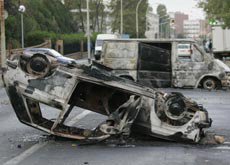
Tuesday, November 08, 2005

Sarkozy and the Media - Kerozene on Inferno.

BAGnews quotes an article from the LA Times saying that
... the first spark of the outbreak can actually be traced back to October 26 when Interior Minister Nicolas Sarkozy led a media contingent to the poverty stricken community of Argenteuil.
In this respect, it is worth noting that Sarkozy made his high profile visit (with loads of journalists) to Argenteuil to meet with police forces at a local police station at night, at about 10:30 p.m. The interesting part is that the police station closing hours are between 6:30 and 7:00 p.m. ... so it remained open solely for Sarkozy’s visit. That looks like a political stunt.
At the same time, the Mayor of Argenteuil, who belongs to the same conservative party as Sarkozy (UMP), said that he only found out about the Minister’s visit through the local newspaper. In other words, he had not been prepared for his visit which may have not helped for things to go smootly (you'd think that warning the local authorities would have been a good idea)
On the other hand, the media are also to be blamed, and that’s particularly true of television. The news htta night all showed Sarkozy using the word “racaille” (often translated by “scum”) but further investigation by other journalists a week later concluded that the word was actually first used by a tenant on the second floor of a high-rise project who was talking with Sarkozy. So the Minister was actually repeating her expression. This may not change anything. After all, he did choose to repeat the word in front of dozens of reporters anyway. Yet, it would have been better to contextualize the event.
Another example of the media’s responsibility is how they chose to stress the controversial parts of the visit. It seems that the evening was not limited to throwing projectiles at the minister (which did happen) nor to Sarkozy's inflammatory words. Sarkozy also had a long talk with the locals, including youths (for about an hour according to witnesses), a talk that went really well. The TV reporters were there but chose not to broadcast any of it in the evening news. I suppose those images of talks were not controversial enough and did not sell well. A France2 journalist, Françoise Laborde has suggested that the editing may have also been the result of some anti-Sarkozy feelings in the media.
All this can be read (in French) here and watched (also in French) here.
I am not trying to defend Sarkozy but a lack of contextualization could only add to the growing tension. At the same time, Sarkozy who has based his popularity on his image of a hard-line, law-and-order demagogue on the issue of domestic insecurity could not afford to look weak and thus damage his presidential campaign.
A few days before his visit to Argenteuil, Sarkozy made the dealines by saying that the ghettos should be cleaned up with “Karsker”. As you can read here,
"Karcher" is the well-known brand name of a system of cleaning surfaces by super-high-pressure sand-blasting or water-blasting that very violently peels away the outer skin of encrusted dirt -- like pigeon-shit
So there is no word in English that translates the connotation of the French word "Karsher". It was clearly understood by many people living in those ghettos as a quasi-fascist insult.
So it is this interaction of blood-thirsty TV and a demagogue politician that was the recipe for a disaster in an already very precarious situation.

|

Tuesday, May 08, 2007

The "American" President of France.

Yesterday, a colleague of mine - a fellow teacher - lamented in the staffroom:
“That’s it. Now, it’s going to be the American way of life in France!!”


The reason of course is that the new president elect of France, Nicolas Sarkozy, has never been shy of his admiration for America – particularly America's strong work ethic and its belief in upward mobility (and for a few of America’s cultural icons such as Ernest Hemingway, Steve McQueen and Sylvester Stallone). He even had his picture taken with President Bush – something a bit risqué before a presidential campaign which was used by opponents to label him as an American lap dog.

His attitude and words are certainly a break from the usual rhetoric of the French elite, either on the right (think of De Gaulle or Chirac) or on the left. [It must be noted that anti-Americanism is not necessarily so prevalent among the French people.]

On the left, Sarkozy has been accused of being "an American neo-conservative with a French passport." Ségolène Royal, his socialist opponent, made it clear she “would never kneel before Bush (a way to suggest Sarkozy would of course). After the debate last week, she also said Sarkozy was imitating Bush's phony compassionate conservatism.

One thing is certain, Sarkozy’s style is not unlike that of Bush: unapologetic, brash, tough-talking and proud of it. And expectedly, the White House and Downing Street were pretty relieved to congratulate Sarkozy and not Royal. Tony Blair (often referred in this country as “Bush’s poodle” even made a congratulation video in French).

So is Sarkozy’s Bush’s new poodle? Is France on the brink of becoming the Troyan Horse of the U.S. in Europe? Will the French become American? Hardly.

True, Sarkozy emphasized strong ties with the U.S. in his acceptance speech:

"I want to launch an appeal to our American friends to tell them that they can count on our friendship, which was forged in the tragedies of history that we have faced together. I want to tell them that France will always be by their side when they need her.”

But he also quickly added:

“But I want to tell them, as well, that friendship is accepting that one's friends can think differently and that a great nation like the United States has the duty to not obstruct the fight against global warming but on the contrary to take the lead in this struggle because what is at stake is the future of all humanity."

At this point, it must be remembered that Sarkozy was primarily elected on a domestic platform: economic reforms and law and order were the major issues.

Now of course, his views of economic reforms are similar to what would be expected of Anglo-saxon conservative politicians: lower taxes, looser employment rules and less importance given to trade unions and he is also likely to agree with Britain and the US on a number of financial issues: accounting standards, banking regulations, air travel, to name a few.

But by underlining one of the major differences between his (intended) policy and that of George Bush when it comes to the environment, Sarkozy has also been very careful to avoid any sense of acquiescence.

In fact, no one is quite certain yet of what he has in mind for foreign policy (traditionally the domain of the president) because very little was said during the campaign but if the style is likely to change, it remains to be seen whether content will vary so much.

Sarkozy opposed the way France tried to block the invasion of Iraq but was against the war. He has also criticized what he calls French arrogance on the world stage but has shown great admiration for De Gaulle.

He has certainly emphasized his belief in a more active role of France in Europe, particularly when it comes to resolving the institutional question and consolidating a political Europe. He also seems to be against further eastward expansion of the EU but the clearest point he made when it comes to foreign policy is his refusal to see Turkey enter the E.U, a great potential source of disagreement with the White House.

On other issues, Sarkozy tends to lean towards Washington and away from Moscow (on the topic of Iran for instance):

"If I become president I will fight on two fronts: first, sanctions against the Iranian regime; secondly, for the unity of the international community, we need the Russians and Chinese to apply the sanctions," Sarkozy said during the election campaign.

As to whether France is going to live “the American way”, this may be the perception of some but it is absolutely irrelevant. First, what is the “American way”? Most of those who fear it have a very dogmatic view based on partial knowledge (sometimes highly influenced by American television shows). Second, one should not confused economics with culture. A more liberal economy (whether you support it or not) does not necessarily equal Americanization.

Last but not least, the U.S. has in fact become the pretext for a very French ideological war which has actually more to do with internal division than with the reality of American influence on France.

To conclude, I'd say that it is likely that France and the U.S. will remain both friends and rivals.

|

A Tale of Two Nations.


Even now, and despite his overwhelming victory, some people find new president-elect Nicolas Sarkozy too divisive for the country. His victory has been greeted by a few riots on the night of the elections and last night.
The unrest has been small-scale, that’s true, but it has sent a message nonetheless: Sarkozy may have won the presidency, but he hasn't won over some French who are dead set against him.

Here's a telling anecdote: the other day, just before the elections, a woman was handing out anti-Sarkozy leaflets in Paris, and she told us “If we don’t win in the polls, we’ll win in the streets”. (By the way, that woman was a teacher which makes you wonder what democratic values she may be teaching!!). Not everyone seems ready to accept the result of the polls. The rationale for that woman was that “Hitler too was legally elected”. Some comparison!

Yet one cannot deny the potential for problems:

Given Mr. Sarkozy’s lack of popularity among the country’s youth, any mass demonstration against his policies would be likely to draw young people into the streets, creating the conditions for even more violent clashes. (NYTimes)

But it would be unfair to say that all this is the fault of one man, he be as controversial as Sarkozy. This divisiveness is much deeper and it is the sign of a very polarized nation, almost as much as the U.S.

The tenet of the Sarkozy vote seems to be twofold: a conservative vote (leaning towards nationalistic values) promoting law and order, and an economic vote, of those supporting radical economic reforms.

When you analyze the details of the election results, you do see two different nations. Reality is always a bit more complex of course, but basically, you have a split between old and young, working and not working (students, and unemployed), urban and rural areas, private and public sectors.

And then there is also a cultural war at the core of which is the battle for the French identity. Unlike in the U.S., this war is not about abortion, gay rights, religion and evolution. Tellingly, it is about history. As recently as last week, Sarkozy attacked the heritage of 1968 which he considers responsible for the breakdown of authority.

He has also constantly dismissed the apologetic vision of France’s darker past, including colonialism

This he hinted at in his acceptance speech:

"The French people (...) have chosen to break with the ideas and habits of the past. I will thus rehabilitate work, authority, morality, respect, merit. I will restore honor to the nation and national identity. I will bring French pride back to the French people, I will end the penitence that is a form of self hatred, and the competition over memory which feeds a hatred of others.”

This may not make Sarkozy popular in French speaking countries, but he probably does not care: they don’t vote for him anyway.

What is most interesting is that Sarkozy’s victory is actually the illustration of a deep rift within the nation.

More pragmatically, Sarkozy’s victory is also Ségolène Royal’s failure. She clearly didn’t win the middle-class. Besides, her electorate voted more against Sarkozy than they voted for her – she failed to convince. The socialists did not lose because they reformed too much but because they did too little, too late. If the socialist party does not reform, like the Labour party did more than 10 years ago, they are unlikely to win any time soon

The parliamentary elections next month will also be quite “interesting”, although most pundits expect the U.M.P. (Nicolas Sarkozy's part) to have a majority of seats. The question is mostly really about how much the opposition gets.

|

Sunday, September 13, 2009

France's Lead on Climate change Issue.

It is not often that this blog has praises for French president Sarkozy - in fact, it’s never happened - but one must render unto Caesar the things which are Caesar’s.

This week, Nicolas Sarkozy laid out his (radical) plan to impose a carbon tax on homes and businesses. Essentially, here’s the idea :

The tax would be initially based on the market price for carbon dioxide emissions permits, which is now euro17 ($24.74) per ton of carbon dioxide, Sarkozy said.

At that level, the government expects to raise euro 3 billion, which will be entirely returned to households and businesses through a reduction in other taxes or repaid via a so-called "Green Check," Sarkozy said.
The result would be a shift of the tax burden from other revenue sources to energy derived from fossil fuels in an effort to discourage their use
.

There are many remarkable things about this plan :

  • First, Sarkozy is delivering on a promise he made during the campaign but also during the Grenelle Environment round-table talks (Grenelle de l’Environnement) – France’s Green New Deal.
  • the French president is fulfilling his promise against public opinion, which is I think a sign a of great leadership. (one does not govern by public polls).
  • France will thus become the biggest country (with the largest economy) yet to try taxes to slow global warming. The smaller countries (Sweden, Denmark, Finland, Norway, Switzerland and parts of Canada) that have adopted similar plans have seen a significant reduction of CO2 emission.

Of course, one may always suspect Nicolas Sarkozy of ulterior motives – his ego showed up again when he talked about “saving the human race”, and of course, it is pretty clear that Sarkozy loves it when he can be in the lead. But so what? What matters also is that the rest of the E.U is likely to follow France’s example, which in turn might give Europe renewed credibility in international talks on climate change.

Of course, it will take strong leadership as people are always keen on helping the environment if someone else pays for it. And the French are no exception.
The most popular figure in France is environmentalist Nicolas Hulot who not only favors the carbon tax but “extracted a promise from all leading candidates during the 2007 presidential election that they would introduce the idea, if elected.” (Carbon taxes were also approved by an environmental conference, uniting politicians of all parties, pressure groups, unions and industry, in October 2007, a few months after President Sarkozy was elected.) Yet now in having to face the reality of it, the French are mostly against it. I understand they may distrust the government giving their money back with the Green check, but they should give it a chance if they have is any coherence.
The worst part is how the socialists jumped on the wagon of criticism on a plan they also initially favored. It blows my mind to see how much they are losing credibility on this (as on so many other things).

The good thing is that the French media – both left and right - have echoed such contradiction :

The centre-right paper Le Figaro says when Nicolas Hulot speaks about the carbon tax, everyone is in favour yet when Nicolas Sarkozy does the same, people disagree. Nicolas Hulot is a famous French television presenter who hosted a series on the environment. He is hugely popular and even considered running for the presidency. In the end, he didn’t but he used his popularity to get French politicians to sign an environmental pact. The paper says the time for words is over, action is needed and the tax should be introduced.

The left-leaning Libération is, for once, in agreement with Le Figaro. The paper says that the Ecology Party will inevitably claim the tax doesn’t go far enough while the Socialists will inevitably say the tax is unfair and hits the poorest hardest.
However Nicolas Hulot’s environmental tax was signed by all concerned so for the sake of coherence, the tax should be brought in and should be supported by all parties.

So the carbon-tax seems to me to be a sensible measure, no matter what ulterior motives Sarkozy may have. The French president has taken a lot of heat both the left who dimed his plan unfair to the poor and the right who fear protectionism in disguise. This makes me think it is actually a good emasure.
Sarkozy found a great ally in Nobel Price for Economics Paul Krugman's note in the NYT - and I could not agree more :

Yet when France’s Sarkozy says something entirely reasonable on the subject — and something that may well be an essential part of the politics of climate change policy — the usual suspects pop up declaring that it’s evil protectionism.
Again, it’s the economic principle that should matter — that and, um, saving the planet, which is is any case more important than the trading system.


|

Sunday, January 11, 2009

Nicolas Bonaparte, the New King George!

You had King George of the United-States, and now, you have Nicolas Bonaparte. That's at least according to this week's issue of French magazine Le Point.
Of course, any historical comparison of our current leaders to kinds or emperors if scary is meant to be satirical yet there are reasons why such analogies come to mind: both George W and Sarkozy have done everything they could (and sometimes more) to reinforce their executive prerogatives.
Much has been said about Bush's (and Cheney's) but you may not be so familiar with Sarkozy's attempt at making the executive more powerful. The latest example in France is the reform of the legal system which would make judges under the control of the administration (and the government).
In both the United-States and France, the idea is to eliminate anything that stands in the way of urgency and efficiency, it be in the name of national security or in the name of much needed reforms. Interestingly both men are impatient and have autocratic temperaments.
Those "osbtacles" however are the basis of a good democratic system of check and balances. And as Arthur Goldhammer said it :
An obstacle removed today in the name of efficiency is a potential point of resistance absent tomorrow when it may be needed. This is not an argument for government by quagmire, in which the headlong rush to disaster is prevented by ensuring that every attempt to move forward ends up to its axles in the muck of soggy opposition. It is, however, a brief on behalf of dialogue. When obstacles are eliminated and carefully prepared reforms rush ahead to conclusion, there is little opportunity to take account of the voices of those affected, whose resistance to change, while sometimes narrowly self-interested, may at other times afford an opportunity to impart useful information to would-be reformers, without which their project, however efficiently executed, is doomed.
In the meantime, the (very British) Independent found other (sometimes irrelevant but funny) reasons to compare Sarkozy to Napoleon
  • Both men are known for their short stature. Nicolas Sarkozy is 5ft 5in and Napoleon Bonaparte was one inch taller (actually above average height for the early 19th century).
  • Both men had foreign ancestry: M. Sarkozy is half-Hungarian; Napoleon came from an Italian-Corsican family.
  • Both men had beautiful wives who were taller than they were.
  • They both set out to reform the judicial system. The Emperor's "Code Napoleon" remains the basis of much of French law to this day. M. Sarkozy has made some piecemeal changes – imposing rigid, minimum sentences for violent crimes and life terms on some sex offenders.
  • Both men set out to change the way that France thinks about itself.
  • Both liked to be regarded as peacemakers. Napoleon's idea of making peace was to make war. M. Sarkozy intervened successfully in the Russia-Georgia conflict in the summer, less successfully in the Israeli assault on Gaza this week.
I would bet that Sarkozy relishes this. One of Sarkozy's cabinet-member-slash-groopies - the Secretary of state for Family Nadine Morano agrees a 100% :
"Who can hold a candle to him? Until now, nobody. For me, there is Napoleon, De Gaulle and Sarkozy. Whoever is in between is peanuts.". (Le Parisien)
But this of course says a lot more about Nadine Morano than about Sarkozy!

NOTE: For more comparison between Sarko and Napoleon, you can always read this.

|

Sunday, March 29, 2009

Sarkoy, Bush and Words

Even though this may seem very trivial to most Americans, the idea of a French president not speaking properly may irritate a lot of French people, and lately much has been said about Sarkozy's butchering the French manguage :

Mr Sarkozy jangles nerves with colloquial tics such as dropping the “ne” between pronoun and verb in negative sentences. “J'écoute mais je tiens pas compte,” he said the other day. (I listen but I don't take notice).
He often uses the slangy “ch'ais pas” for “je ne sais pas” and “ch'uis” instead of “je suis”.

Like Tony Blair with his pseudo estuary-speak, Mr Sarkozy is a lawyer with a posh education who uses low-class tones as a way of endearing himself. The style grates because of France's attachment to language as a unifying force. Most previous leaders have cultivated a literary side, including military ones such as Charles de Gaulle and Napoleon Bonaparte.
The President stands accused of setting a bad example when he is trying to stem a
decline in literacy.
(Times)
His language mistakes are even compared to those of George W.Bush (An insulting comparison in France,) with a smilar goal of trying to reach "everyday Joe". There is for sure a comparison to be made in the divisive nature of both presidents' rhetoric.

".... the visceral dislike of Sarkozy that is so widespread in France [is likened] with the Bush phobia that was until recently so rampant in the US." More interesting, is the idea that "one of the reasons Obama won was that he never ceded to the facility of Bush-bashing. I think there's something to this observation."

On his blog, Arthur Goldhammer says...
[he] has been struck at times by Sarkozy's fluency without a teleprompter. Bush could never have survived if presidential debates in the French format were a part of American campaigning. He could occasionally read a speech well, but on his own he was helpless, and his face always revealed his panic. Sarkozy is never at a loss for words, and he doesn't always "parler peuple" when on his own. He is an actor, who knows how to control his effects and his voice. His body language needs work, as does his superego: his greatest vice, it seems to me, is his inability to conceal contempt without great effort. He likes to let people know how little he thinks of them.

As for recognizing that reasonable people may disagree with what he says, yes, but with one caveat: he has a (lawyerly) habit of reducing complex issues to a stark alternative: it's either X or Y, and Y is so clearly inferior that what would you have me do, if not X? I've remarked on this before, and on the often obvious R,S,T, U,V,W, and Z that might be discussed as alternatives. It's a lawyer's trick, but one that he uses well, unlike Bush, who occasionally tried it ("You're either with us or against us" comes to mind), but so crudely that the gambit was pointless.

As for the penchant for "parler peuple," times change.
Roosevelt could become a secular saint even with his patrician accents, but I don't think any American politician with that accent could be elected today (think of how Bush Sr. was ridiculed whenever he showed patrician touches). Even Obama does it. Even I do it: I don't speak with the same grammar or diction to the UPS deliveryman or the carpenter as I do to my colleagues. It's instinctual, not calculated. And I am more likely to think of an American-born professor who affects an Oxbridge accent as a hypocrite than I am of a politician who modulates his tone to what he believes his audience expects. And as for literature, Richard Poirier thinks that the distinctive mark of one of our greatest literary stylists, Saul Bellow, was his unparalleled ability to veer from the high-flown to the demotic in mid-sentence. In a sense this pliability is the essence of the American language, and in this respect, perhaps, the epithet "the American" really does attach to Sarkozy. Destarching official French has its virtues.
I agree Sarkozy is more convincing than Bush ever was and he is in his own way a master of (populist) rhetoric, but even though Sarkozy's speeches appealed to the French when he was a candidate for the presidency, they have made people really tired. The French expect more from a man who represents their country anyway.

Besides, however powerful it may be, Sarkozy's habit of reducing complex issues to binary solutions is something that makes me uneasy. I suspect it is not the sign of good pedagogism (as in Obama's case) but that it reflects his lack of understanding of the complexity of many of those issues. This binary view may be the reasons for many of the hasty decisions and the ill-conceived laws he has initiated.

|

Sunday, November 15, 2009

Sarkozy, the Rejected Suitor.

This week Nicolas Sarkozy decorated Clint Eastwood with the order of Commander of the Legion of Honour, the highest decoration in France (established by Napoleon Bonaparte in 1802).Eastwood was actually ‘upgrade’ from ‘knight of the Legion of Honor’ previously given by Jacques Chirac.
Charles Bremmer asks a pointed question :
What is the service that Eastwood has rendered ?
Sarkozy's office says the honour is deserved because Eastwood "is a global star who is very fond of France.".

This is not only strange, it is typical, as Bremmer said, of the lingering love-hate relationship between the U.S. and France.
Sarkozy’s case is different from his predecessors’ though. After he initially threw himself into the arms of the US, he now acts more like a rejected suitor.
He took his first summer holiday as President in New England, not far from the Bushes. He has cooled off in a big way. Obama's refusal to take up his offer of special complicity has been taken as a personal affront by the French President. On Monday, he tore a strip off Obama over his failure to come to Berlin for the Wall celebrations, according to a leak of his remarks in le Canard Enchaîné. [French satirical paper].
"Obama is very disappointing in foreign policy. He doesn't just have difficult relations with me," he was quoted as saying. "It's the same with (Chancellor) Merkel and (Prime Minister) Brown. Europe does not excite him. As for the rest of the world, it's a disappointment too. The language has changed. There has been an opening up. The hand is outstretched but it is grasped by no-one."
A few days earlier Sarkozy launched into an anti-Obama tirade at the weekly cabinet meeting, comparing himself highly favourably with the US president, who, he said, had only managed to produce a single reform so far.(Le Canard is usually quite accurate with its Sarkozy quotes. Ministers read it closely to find out what the boss is
thinking).
Sarkozy should take this as humbling experience rather than a personal smack, but I am afraid his ego is way too big for him to put it all in perspective. The fact remains that for Obama, Europe is less relevant that it used to be and France better get used to it.
Meanwhile, Sarkozy tried (too) hard this week to “emulate the gesture of reconciliation by the late President Mitterrand when he held hands with Chancellor Helmut Kohl at the Verdun battlefield in 1984”. This seems more like a desperate move after failing to build up a new relationship with Britain. Besides, Angela Merkel may not be so keen on those big shows of unity.
"France looks a little like the rejected lover in this couple de raison," le Monde said on Wednesday..
The fact that Sarkozy is down in the polls makes some grand scheme of unity probably more relevant to refurbish his image. That, and the French identity debate. His behavior, his lack of tact and finesse are quite embarrassing but unfortunately, they are neither new nor unexpected.

|

Wednesday, December 07, 2005

Martinique 1, Sarkozy 0

What 2 weeks of social unrest and burning cars have not managed to do, Martinique did: for once, French Minister of the Interior Nicolas Sarkozy had to back off
- and postpone his trip to the French West Indies (which are French overseas “departments”) as many local organizations and a number of elected officials and union leaders were ready to protest Sarkozy’s arrival. Why is that?
Well, officially they want to protest a law, discreetly voted last February, which requires teachers to “teach the positive side of colonialism”
(here's the text in French), a sensitive issue in the Dom-Tom whose black population descends from the French slaves.
Despite the strong opposition of many historians and prominent figures, the shameful law has not been cancelled. It blows my mind that Sarkozy dared talk about "misunderstandings" (malentendu) concerning the law. There is no limit to this guy's arrogance for he is
the one who fails to understand the anger that surrounds both this law and his persona. (well, actually he does know and enjoys every bit of it)

Even though Mr Sarkozy is not directly responsible for the law, it is his whole persona as well as the words he has recently used (words that sparked the social unrests in France last month) which can explain such resentment.

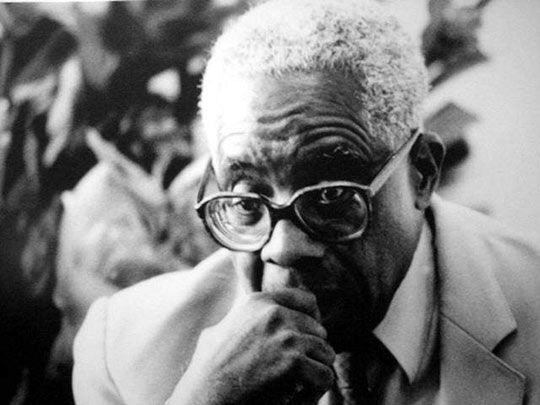
It is also the ambiguity of his role- he is at the same time a Minister in De Villepin’s Cabinet, a leader of the conservative party (UMP) and a candidate for president. Clearly he has been using his position as a minister of the Interior to promote his personal agenda and candidacy. That is also why Aimée Césaire, the famous and much respected Martinican author, has refused to meet with him for fear of having the image of their meeting used for Sarkozy’s own promotional campaign as well as to protest the pro-colonial law. Smart move for an old guy!

All this is once again a sign of the changes taking place in France and the tensions bred by the resistance to those changes. The riots in the impoverished suburbs, the issuing debates over racial integration, the role of religion - all have taken their tolls on the French self-assurance. The French old Republican model is about a 100 years old and it is aging and cracking on all sides. It needs some good fixing but the fixing may be a painful process and some people don't want it.

So right now, this resembles a real cultural war - not unlike that in the US - and the stakes are high as the winner is likely to reshape part of the French identity.
[sorry for this binary view, but there are times when things need to be pushed a little to the extreme for sake of clarification]
One illustration: last week, the French (ruling) conservative party (UMP) - whose leader is Sarkozy - rejected demands for repeal of the pro-colonial law. On what ground? Probably because the repeal was asked by the opposition, but also because the fringe of their electorate that benefited colonialism has not died yet. Strangely enough, the divide there is also generational, just like the devide between those who support Sarkozy and those who feel strongly against him.

In concrete terms, we can only hope that the French government and legislature soon give in to the demand to repeal that pro-colonial law and that the country as a whole swiftly responds to the recent wake-up calls about racial integration. But that's not going to happen overnight. In the end, I still think this is actually a great opportunity to face the real issues and be done with taboo subjects. I also believe that "resistance is futile" because our society can only move towards more integration and a reviewing of history which includes the contribution of "visible minorities". That can happen through pain and resentment or in a peaceful way. Unfortunately amibitious Sarko is not ready to make peace.

The most satisfying thing in the present "game" is that today Martinique and Césaire definitely scored points for the "progressive" team and it is always so entertaining to see the other team lose some .

|

Sunday, September 16, 2007

What Bush and Sarkozy REALLY have in common: the DEFICIT!

You may have read the comments over Greenspan’s criticism of the Bush-Cheney’s abandonment (along with the Republican-controlled Congress) of their party’s principles on spending and deficits. in his memoir to be published tomorrow.

“They swapped principle for power. They ended up with neither. They deserved to lose” in the 2006 election, when they lost control of both the House and Senate. (NYTimes)

This is obviously a major embarrassment for the White House even if Greenspan’s economic authority may be somewhat undermined by the current bust of the housing bubble fueled by low interest rates and risky mortgages over the past six years and by his own admission, he failed to see the danger.

Even if the situations in France and the U.S. are very different, it is somewhat ironic that Sarkozy has also taken measures that have worsened France’s deficit:

… far from helping to rein in the country’s bloated budget deficit, the early measures will in fact stretch it further – by as much as 0.6 per cent of gross domestic product, according to Barclays Capital – while only marginally boosting consumer spending. (FT)

Sarkozy has responded to the criticism by lashing out (again) at the European Central Bank which has infuriated Germany who is a strong supporter of the bank’s independence.

This is nothing new of course:

The rift between Sarkozy and Trichet has its roots in French politics more than a decade ago when as head of the Bank of France, Trichet sparred with then-Budget Minister Sarkozy over budget-deficit targets. It deepened when Sarkozy made the ECB a target during his election campaign. (Bloomberg)

I find it ironic that that it is those so-called conservative governments who have increased the deficit while accusing the left of doing exactly that if they were elected. That was the case between Bush and Gore as it was between Sarkozy and Royal.


|

Sunday, March 18, 2007

How Sarkozy Attempts to Indimidate the Press!

Apparently conservative contender for the French Presidential elections and current Minister of the Interior, Nicolas Sarkozy is entrenched in the old idea that the media can be controlled by politicians, an idea prevalent amongst French presidents from De Gaulle to Chirac.

Sarko did not like the headline of left-wing newspaper Libération which read “Sarkozy's Tax on wealth: the suspicion”.

The “suspicion” was that Sarkozy may have undervalued his asset in order to pay less of France's special tax on the wealthy, l’Impôt de Solidarité sur la Fortune (paid by individuals whose net worth is higher than €760,000, or about a million U.S. dollars). The same “suspicion” has been raised with the socialist candidate by the way.

But in Sarkozy’s case, it went a bit further. According to some French press (here, here, and here) Sarkozy lashed out when he called - not the editor but the main stockholder of the newspaper, Edouard de Rothschild to express his displeasure. He is reported to have added that “this would certainly prevent the daily from finding people to finance it”. [Libération has had financial problems in the last few years]. The exchange between the two men was allegedly tough, and the presidential candidate is even said to have been angry enough to be rude, calling Libération “a shitty newspaper”.

Now, interestingly, this happened about 2 weeks ago and it really did not make the headlines in France.

But is it a good sign that a politician who seeks the highest office in the nation, a man who may become the “guarantor of the institutions”, and a man who is still the Minister of the Interior should try to intimidate the owner of a newspaper?

In this particular case, it is unlikely to change anything – Sarkozy’s phone call is reported to have “made Edouard de Rothschild laugh a lot”. Certainly, de Rothschild can afford to laugh it off but still, this is really not a good sign, and it is undoubtedly something that should have made the headlines.

|

Wednesday, September 13, 2006

Sarkozy Woos Americans.

In the meantime, Nicolas Sarkozy, France’s leading presidential hopeful on the right, was touring the U.S. He said that "critical accounts of the United States in the French media often do not reflect the true feelings of the French people". He also said "the French love American food, its television programs and its movies. "Every French parent dreams of sending their child to an American university,".(Wash. Post)

However I may disagree with Sarkozy on many issues, he has a point here, when he blamed misperceptions about the United States on French "elites and journalists." In many ways, anti-Americanism is a game played mostly by the intellectuals and some of the elite.
It must also be noted that where you stand with regard to "America" often reflects your political views in France. In other words, the topic of "America" is a political one and so it is not surprising that Sarkozy should also use it.
His tough stance on many issues - from immigration to foreign policy - is a light version of what the Bush administration stands for. During the war between Israel and hezbollah last summer, Sarkozy has strongly expressed support for Israel, holding the Hezbollah guerrillas fully responsible for the war.
This may very well be PR for America and for the rest of the world. Strangely enough, his views in this matter have not made the headlines in France. In fact, there have been very few pictures of his meetings with President Bush (admitedly an exceptional event for a mere minister) and Secretary of State Condoleezza Rice.

Sarkozy gave an interview to
French daily Le Monde on this topic of his relationship to the U.S. [here in French or here in English (via SuperFrenchie)].

There too, he said a few things I must admit I wholeheartedly agree with (as expressed in this post):
The threat of a veto was useless, initially because there would never have been a majority on the Security Council in favor of war, and secondly because it led to a feeling of humiliation in the US.
The more general statement he made is also something anyone who likes the US will probably agree with:
I like the energy and the fluidity of America. The sentiment that everything is possible. This impression — perhaps artificial — that great stories are possible, that you can start at the bottom of the ladder and climb very high, or perhaps the opposite. The Enron affair is fascinating and it has a moral. The U.S. not only cultivates successes like Bill Gates, it also punishes mistakes.
One could argue that if Sarkozy became the president of France, Franco-American relationships would improve. I am not actually so sure. In any case, as appealing as the idea of better relationships between our two countries may be [it is after all the whole idea of this Blog], it is not enough for me to even consider voting for him. Unfortunately, there is a lot more I disagree with.

|

Saturday, October 17, 2009

Nicolas Bonaparte's King Making.

The most scandalous political news these days come from France again, not from the U.S.. It is a change from the Bush era and it seems that French President is trying hard to outdo King George.

It is no surprise to those of us who have seen the early signs (here and here) that the the comparison between Nicolas Sarkozy and Napoleon had direct bearing on the governance of France.


After scandals over sex tourism (see our two previous posts), racist-sounding chaffing, now comes nepotism :

The French people found out this week that the president's son, Jean Sarkozy (i.e. as 'Prince Jean'), is a candidate chairman of the development agency for La Défense (called EPAD), a high-rise financial center to the west of Paris where major top firms have their headquarters - an area which is supposed to develop and compete with London.


Not only is Jean Sakozy only 23 years old, but he has not even finished school yet - he is repeating his second year of undergraduate law at the Sorbonne (after repeating his first), and has virtually no experience. Sure he was elected as a department councillor of the Hauts-de-Seine, but he complished little as he won the Neuilly seat, in his dad's conservative fiefdom.


He was then given the job of heading his dad's political party (UMP) in the department.


The French satitirical newspaper Le Canard Enchainé (not available online) has also investigated on how the whole process was planned by the Elysées for more than a year, (by either forcing or coaxing people into giving up their seats to make sure there would be no opposition in the EPAD body).


As you can imagine, this has provoked an outcry in France, and even made the headlines in China. A majority of French people find it scandalous 63% oppose the decision... What why 37% don't seem to be bothered.


I suppose some people may be blasé. It is true that political dynasties are nothing new in France where the presidents are more elected monarchs (who act as if they had been given all powers for term, not unlike George W. Bush) than modern presidents.


But this is different because Nicolas Sarkozy ran his presidential campaign claiming that his self-made man background made him different from the politics-as-usual. He was elected on the promise of a new "irreproachable republic" based on work, merit and the end of "birth privileges". The hypocrisy is killing me.

But here's the icing on the cake - on the very day following the news of his son's appointment, President Sarkozy gave a speech on education reform in which he praised Napoleon Bonaparte for having founded an egalitarian high school system that effectively ended "the privileges that come with birth" into families of high standing, adding that "to succeed in France, what counts is no longer being well-born, but having worked hard and proven yourself through your studies and work."

And he said it with a straight face.


Indeed he was right, Napoleon seems to be more relevant than ever - Napoleon, also known as the "King Maker" was the master of nepotism, making his family members kings and queens of countries he had invaded.


Hopefully for his own sake (and for the French) Prince Jean will not be another King of Rome but we may not get rid of Sarkozy dynasty so easily. Jean Sarkozy and his wife are expecting their first child by the end of 2009.


UPDATE : Under enormous pressure from negative public opinion - including petitions and funny flash-mob demonstrations in which young people wielded bananas like mobile phones (video) as reference to the Banana Republic France is becoming - Prince Jean finally gave in and said he would not seek the presidency of the organization that runs France’s most important business district

|

Friday, July 25, 2008

Obamania in France.


Things have definitely changed for the better between France and the U.S. in the last 5 years, since our two nations got into a major row over Iraq. A new French president has been elected, despite his vocal admiration for the United-States, the war in Iraq has been proved to be a political failure, and there are American elections coming up.

Does it mean that “the average American has enormous fondness for the French people," as Obama said?

Well, the very fact that Obama showed himself with a French president is a sign that perceptions have changed. That would have never happened in the last presidential campaign:

Four years ago, Senator John Kerry spent months fighting back impressions that he appeared too French – even though he wasn’t – and conservative commentators used to create a caricature that likely affected his candidacy.

At the same time, and contrary to what happened in Berlin, Obama is not looking to draw crowds in Paris "because he knows his huge popularity in our country could ill serve him with a part the American centrist electorate.", as conservative newspaper Le Figaro wrote.

As usual for Sarkozy, there is no hesitation of show of emotions (which makes a lot of French a bit uncomfortable):

"Obama? He's my buddy," Le Figaro quoted the president as saying before Obama's arrival. "I am the only Frenchman who knows him." (AP)

It is true that Sarkozy met with Obama in 2006, before he was president. But he also met with McCain back then. However, both candidates have had different treatments:

Obama's reception in Paris contrasted with how his rival, Republican John McCain, was received in March. Obama was greeted by a smiling Sarkozy, who returned to Paris for the meeting from another summit. The joint Sarkozy and Obama news conference was held in front of the Elysee Palace; after Sarkozy and McCain met, the senator fielded questions alone from reporters in the courtyard. (LATimes)

Maybe Sarkozy genuinely prefers Obama or he’s trying to capitalize on Obama's great popularity among the French.

One thing that must be kept in mind is that actually very few people in France and in the world know anything about Obama’s policy. I even suspect that most people don't even want to know much.

All people outside America seem to care about is that he is not G. W Bush for one, that he is young (à la Kennedy) AND that he is black.

Interestingly, Obama’s candidacy resonates in the tougher neighborhoods of France where it triggers discussions about France’s own political integration of minorities (or lack of thereof). Ironically, it seems it in those neighborhoods that American foreign policy is most strongly condemned that Obama and the American model of integration are most highly regarded

If elected, President Obama may end up being a great disappointment, given how high the expectations are, but he will have accomplished two things: to make people believe in the possibility that there is an American dream somewhere out there, and improve the credibility of American foreign policy in the world, when it comes to justice and fairness.

|

Sunday, May 10, 2009

France and Freedom of Speech: the HADOPI case AGAIN!


This is not the first time that we have called into question freedom of speech in France, but this is a pretty 'good' one.

Here's "le premier martyr d'Hadopi." - a man sacked by a French tv channel for criticizing HADOPI to his Member of Parliament(see our previous post)
A Web executive working for TF1, Europe's largest TV network, sends an email to his Member of Parliament opposing the government's "three strikes and you're out" proposal, known as Hadopi. His MP forwards the email to the minister backing Hadopi, who forwards it to TF1.

The author of the email, Jérôme Bourreau-Guggenheim, is called into his boss's office and shown an exact copy of his email.

Soon he receives a letter saying he is fired for "strong differences with the [company's] strategy" — in a private email sent from a private (gmail) address. French corporations and government are entangled in ways that Americans might find unfamiliar. (Slashdot)
This should not be a surprise given the "incestuous relationship" between French president Sarkozy and Europe's largest TV network
TF1's owner, the construction billionaire Martin Bouygues, is godfather to Mr Sarkozy's youngest son, Louis. Mr. Bouygues suggested to Mr. Sarkozy that he ought to ban advertising on TF1's rival stations in the public sector, which was done in January.
Laurent Solly, who was deputy director of Mr. Sarkozy's presidential campaign, is now number two at TF1.
Last year, TF1 sacked Patrick Poivre d'Arvor, the station's star presenter for the previous 21 years. Poivre had angered Mr Sarkozy by saying he "acted like a little boy" at a G8 summit. He was replaced by Laurence Ferrari. Mr. Sarkozy reportedly told Mr. Bouygues he wanted to see the young blond on the news.


|

Sunday, February 01, 2009

Nicolas Bonaparte Strikes Again!

If you need one more examples of why the accusation that Sarkozy has been acting like a monarch (or an Emperor, maybe) rings true, here’s one from this week :
The latest victims of presidential pique are two recently-appointed officials who had overall responsibility for public order when M. Sarkozy visited lower Normandy to speak on education reform on 12 January. About 3,000 demonstrators protested. M. Sarkozy was furious the demonstrators had been allowed to come so near that he could hear them faintly.
He was heard to say at the time: "Quel con, ce préfet." (What an arsehole, this prefect is.) A prefect is a governor appointed by the state to oversee the administration of each département. On Thursday, it was announced that the prefect of the Manche département, Jean Charbonniaud, was being moved to another job.
Yesterday it emerged that the director of police in the Manche, Philippe Bourgade, had also been told to "look for another post".

This is somewhat ironic since Saint Lô was placed top of a nationwide ranking of police efficiency in 2008 in a poll for the newspaper Le Figaro, with double the national average of crimes solved, especially when you consider that Sarkozy made his name as a tough-talking interior minister obsessed with quantifying police efficiency.
Of course Sarkozy had the right to demote those men. But his actions were totally disproportionate. As the fired police chief said,
"What was so terrible about what happened? The President heard a few whistles, that's all."

Outrage has followed of course, and not just in the opposition. Even members of Sarkozy’s own party have been critical:
"It is lamentable if representatives of the state are being treated like Kleenex. It's scandalous," said Jean-François Le Grand, UMP head of the Manche county council.

This is nothing to be surprised about :
Last year the president ordered the firing of a successful Corsican police chief after nationalist protesters had invaded the garden of his friend, the actor Christian Clavier.

|

Sunday, February 04, 2007

Charlie Rose - An hour with Nicolas Sarkozy

Last week, Charlie Rose (PBS) interviewed Nicolas Sarkozy, Interior Minister of France and the UMP candidate for the French presidency. If you want to have an idea of who are the two main contenders for this year's presidential elections in France, the beginning is a good introduction. The interview itself is also pretty good. Charlie Rose does not spare his interviewee the tough questions.
As a teacher of English, I may be a bit too sensitive to this issue but I find it appalling that Sarkozy does not speak English and actually needs a translator... He was after addressing an American audience. What kind of world leader is this? Today, it is clear that English is needed for diplomacy and for interacting with other leaders at a more personal level.
Recently, when Sarkozy met with Tony Blair, and well... they spoke French. Good for Tony but it's not exactly like everybody in the world speaks French fluently. Recently, some people in France took offense at the fact that the UN Secretary does not speak French fluently and prefers spaking English. Well, maybe the French leaders should begin to acknowledge reality and adapt to today's world! This is worrisome for the so-called new generation of French politicians. (Chirac, Jospin, or de Villepin all speak English reasonably well..)
It seems that the other main contender for the presidential race (French socialist candidate Ségolène Royal) does not speak much English either (watch a video here). Sad!
The irony is that Sarkozy often shows himself quite an Anglophile, and even an Americanophile in some instances... so you'd expect him to speak English well enough! But no, he doesn't! The latter may explain the former, cynics might say!

It is also worth noting that at some point Sarkozy presents himself as a self-made man who had to fight to make it to the top. This is not entirely true and as you can read in his biography, he came from a fairly wealthy family and spent most of his life in the wealthiest exclusive Parisan suburb of Neuilly of which he eventually became the mayor. This of course does not mean he's not a skillful politician who has worked hard to make it to the top... but let's not buy into the entire myth of the man who's made it from the bottom to the top! Sarko's life is no Horatio Alger story!

Enjoy the video...

|

Sunday, October 15, 2006

French Presidential Candidate Sarkozy Insecure about his Height.

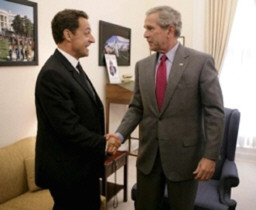
I missed a good story on Nicolas Sarkozy (France’s leading presidential cindidate on the right) from last month. We did mention his informal meeting with George Bush on Sept. 12, but to my great shame I failed to see what the French satirical newspaper Le Canard Enchaîné did notice:
The only official picture would seem to indicate that he may have surprinsgly grown in height - literally. On the picture, he looks as tall as president Bush.
The problem is that Bush is about 6 ft (1.83m) tall but Sarkozy is much smaller, and there's proof of it.

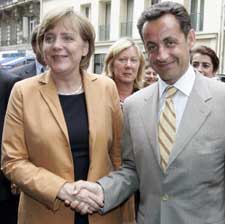
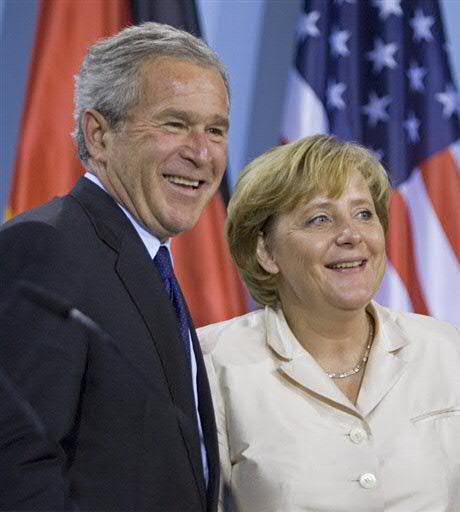
As you can see on the following pictures, Sarkozy is about the same height as Chancellor Merkel but Merkel is much smaller than Bush (about 7 inches).

According to Le Canard, when Sarkozy met with Tom Cruise, he was about the same height, and Tom Cruise is 5.51 ft (1.68 m). His staff says he is "officially" 5.57 ft (1.70 m). Still, there is no way he could be as tall as George Bush.
The fact that he is small is irrelevant to me (I am not the tallest guy in the world myself) but the fact that Sarkozy is so insecure about his height that the picture should have been altered is really weird.
[or maybe he had hyge hidden heels, who knows...]
(here are other sources in French in Le Monde or Le Nouvel Obs)

|

Wednesday, November 02, 2005

Riots in Paris Suburbs Getting Worse.

For our readers who do not reside in France, here's the important news making headlines in France. For the last six nights, the police have clashed with angry youth and every night the TV news programs have shown guerilla-like images of those suburbs.
What ignited the whole crisis was the death of two teenagers who were electrocuted while trying to hide from the police in Clichy–sous–Bois , northeast of Paris. When word got out, other kids turned to the streets in large numbers and had a major riot, mutinied for hours and hours and pushed a truck into a social security office, attacking a police station, burning up 20 cars and generally running the police.
Now, an element not put forward by most French media is that the the rampage in Clichy-sous-Bois started with an attack on firefighters called in to help the two youth, who died after seeking cover next to an
electrical transformer. A third youth suffered serious burns.
Then the Minister of Interior Minister Nicolas Sarkozy went to Clichy, got pelted by stones and then called the youth there "scum" or "riffraff," echoing what he said in the past when he had vowed to "clean out" the suburbs.
Needless to say, those tough words only fanned more violence. One thing led to another, including a tear-gas grenade reportedly thrown into a mosque by the police sending Muslims at prayer fleeing into the street. Sarkozy confirmed the tear gas grenade was thrown into a mosque but added that "this doesn't mean it was fired by a police officer".
Sarkozy was on TF1 TV–news last night where he proclaimed 'zero tolerance' for 'those who don't respect Républican order,' and the paper Le Parisien repeated this with its major headline of Tolérance zéro on today's front page. He explained his words by saying
'I speak with real words,'' Sarkozy told Wednesday's Le Parisien newspaper. ''When you fire real bullets at police, you're not a 'youth,' you're a thug.''

While Sarkozy may be right - those youth who rioted because two kids stupidly hid in an electric transformer station should be punished - his bravado attitude can only make things worse.
My teaching experience in those suburbs has taught me that playing those macho games is pointless and often leads to violence. Sarkozy should really learn to act with civility himself and show less of a temper but that is hard when you have such an ego. Imagine a US Attorney General visiting New Orleans saying he's going to "clean up the gangrene".

In the meantime, Chirac is non-existent. He only issued a statement "calling for calm" through his spokesman. It really is about time he retire!

|

Sunday, June 07, 2009

Obama, Sarkozy, and the meaning of "friendship" in France and the U.S.

What is interesting when you see Obama abroad is the reaction of world leaders who he visits.
Obama is actually the cool guy on the block that everybody wants to be friend with and seen with because it makes them cool and popular.
It is to the extent that there is a competition as to who is the best friend of the cool guy. And no one in Europe has been more eager to compete for Obama than French president Sarkozy - as boyish if not childish as he is. Of course, the French media have played along, spending hours of live coverage of every move of Obama during his visit for the D Day commemoration. (Sadly,the European elections today don't seem to get the same attention!)


There has also been a lot of speculation in the French and German media as to why the U.S. president was spending so little time in Europe, the French press making ironic comments about how Sarkozy's ambitions was thwarted by the White House.

But finally, Sarkozy got his much anticipated "Obama moment" when the two presidents gave a joined press conference yesterday-.

Very important things were said about Europe, Turkey and North Korea but that's all in the news media. I'd like to focus on something that President Obama said, which I find culturally interesting -

Asked about the alleged snub of President Sarkozy, he said this:


The United States is a critical friend and ally of France and vice versa. I personally consider Nicholas Sarkozy a friend. I think he feels the same way. And so since I know I can always pick up the phone and talk to him, that it's not necessary for me to spend huge amounts of time other than just getting business done when I'm here. (Fox)
What is interesting in this short quote is that it defines very well how American see friendship, which is very different from the way the French see it, even though the term has apparent very similar meaning in both cultures.


Americans tend to emphasize reciprocity and balance ("vice-versa") as well as a strong sense of independence. Distance between friends is not a problem ("no need to spend huge amounts of time") and in fact, it may be guarantee of good friendship which needs not to be proven by constant reminders of its existence. On the contrary, depence is perceived as a problem which could become "co-dependence", a term that simply does not translate into French and means that the relationship is unhealthy and should be terminated.

The French have a very different view of friendship. For one thing, the term "friend" is not as lossely used as in American English. (as an example, a lot of French people find the use of "friends" on Facebook a bit... excessive). Contrary to the U.S., you don't call someone you hardly know a "friend". The reason is that friendship in French culture implies more intimacy to the point that it may even be ok to burden your friends with your problems without expecting reciprocity. In fact, the French tend to think that true friendship should weather just about anything including the feeling of invasion, being teased, discussions bordering disputes, etc... - things that would be unbearable to most Americans.


Raymonde Caroll - a French anthropologist who wrote about French-American cultural misunderstandings - argues that American friendship is similar to love: your friend are there to support you, approve of you, give back to you a confirmation of yourself", while French friendship is based on family relationships, and resembles a family circle - the only difference is that it is freely chosen. In fact, friends in French culture can be seen as a substitute for family ties which I think, is very telling about the central role of family life in France, even today.

This difference partly explains some problems in international relations and why so many Americans find French criticism at odds with their sense of friendship, while the French think that only criticizes people precisely because they're your friends (which you would not do with strangers).

Raymonde Caroll also makes another observation which, in my experience rings ver true :

A French person without friends would be [considered] asocial, an American without friend would be [considered] anti-social.

This whole topic may seem trivial to you but I believe if world leaders took intercultural crash courses before they meet, the world might run slightly more smoothly. Personally, as it turns out, if I had been told about some of those differences, I might have avoided a lot of unpleasant moments of embarrassment and misunderstandings - if not downright conflicts - with a number of "friends" on the other side of the Atlantic, the trick being precisely that appearance of commonality can be all the more deceiving that our cultures seem similar enough, only the same words sometimes carry totally different connotations and meanings.

|